Krazati (adagrasib)
Mirati Therapeutics (now a Bristol Myers Squibb company) · KRAS G12C Inhibitor
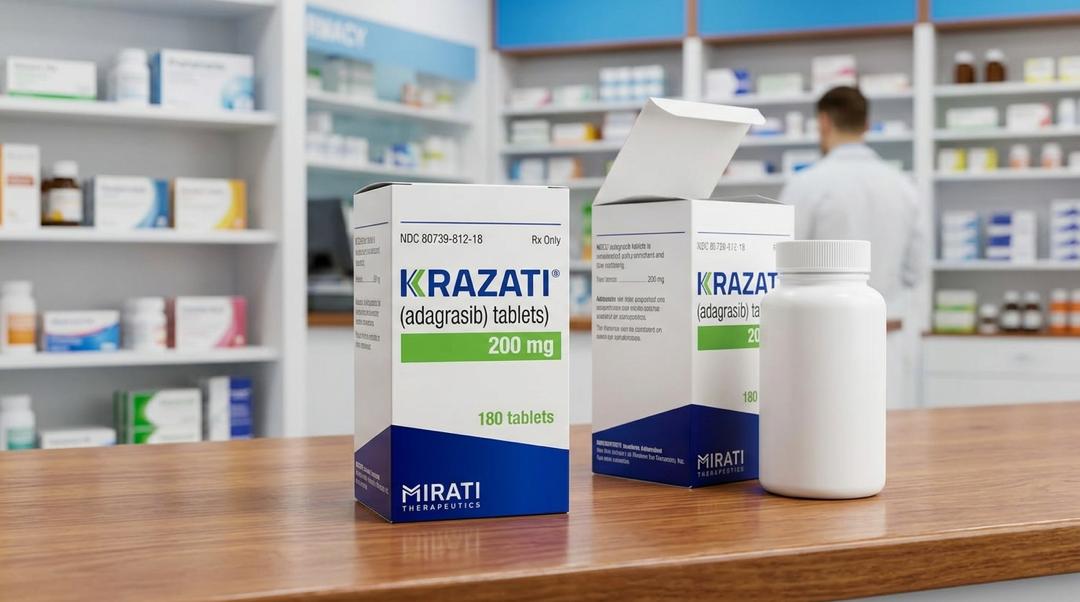
What is Krazati? Krazati (adagrasib) is a KRAS G12C inhibitor by Mirati Therapeutics (Bristol Myers Squibb) approved for adults with KRAS G12C-mutated locally advanced or metastatic non-small cell lung cancer (NSCLC) after at least one prior systemic therapy.
About Krazati
| Brand Name | Krazati |
| Generic / INN | adagrasib |
| Drug Class | KRAS G12C Inhibitor |
| Manufacturer | Mirati Therapeutics (now a Bristol Myers Squibb company) |
| Administration | Oral tablet |
| FDA Approval | 2022 |
FDA-Approved Uses for Krazati
Indications are based on FDA approval. Your healthcare provider determines appropriate use based on your specific diagnosis, stage, biomarker status, and overall clinical picture.
- Locally advanced or metastatic NSCLC with KRAS G12C mutation — adults after at least one prior systemic therapy
How Does Krazati Work?
Adagrasib irreversibly and selectively inhibits the KRAS G12C mutant protein by covalently binding to the cysteine residue introduced by the G12C mutation, locking KRAS in its GDP-bound (inactive) state. This prevents RAS-driven downstream signaling (RAF/MEK/ERK, PI3K/AKT) that drives tumor cell proliferation.
Dosage & Administration
400 mg orally twice daily (800 mg/day total), with or without food. Avoid strong CYP3A4 inhibitors/inducers. Dose reductions to 200 mg BID or 200 mg QD for toxicity.
Warnings, Precautions & Side Effects
General Warning
Gastrointestinal toxicity (nausea, diarrhea, vomiting) — very common, often dose-limiting. QTc prolongation — EKG monitoring required. Hepatotoxicity — monitor LFTs. ILD/pneumonitis. Embryo-fetal toxicity. CNS effects.
Common Side Effects
- Nausea
- Diarrhea
- Vomiting
- Fatigue
- Musculoskeletal pain
- Hepatotoxicity
- Decreased appetite
- Constipation
This is not a complete list. Always report new or worsening symptoms to your healthcare provider promptly.
Storage & Handling
Store at room temperature 20°C to 25°C (68°F to 77°F).
BiologicHealthPlus provides temperature-monitored cold-chain specialty delivery for medications requiring refrigeration. Never use a medication if its storage conditions have been compromised.
Insurance Coverage, Prior Authorization & Patient Assistance
🛡️ Commercial Insurance
Krazati is covered by most major commercial insurance plans when medically necessary and prior authorized. Coverage tier and cost-sharing vary by plan.
✅ Prior Authorization
Prior authorization is required by virtually all insurance plans for Krazati. BiologicHealthPlus handles the complete prior authorization process at no cost to patients or providers.
🏥 Medicare Coverage
Medicare Part D covers this oral specialty medication. Medicaid coverage varies by state.
🆓 Patient Assistance
Manufacturer patient assistance programs may be available for eligible uninsured or underinsured patients. Contact BiologicHealthPlus for a confidential eligibility review.
Prior Authorization Patient Assistance Insurance & Savings Medication Costs
Frequently Asked Questions — Krazati
Krazati (adagrasib) is a KRAS G12C inhibitor approved for KRAS G12C-mutated NSCLC after prior systemic therapy. It irreversibly locks the KRAS G12C protein in an inactive state, blocking tumor growth signals.
KRAS G12C is a specific activating mutation in the KRAS oncogene — where glycine at position 12 is substituted by cysteine. This mutation is present in about 13% of NSCLCs and was long considered 'undruggable' until the development of covalent inhibitors like adagrasib and sotorasib.
Both are KRAS G12C inhibitors, but adagrasib (Krazati) is taken twice daily and has somewhat different toxicity and drug interaction profiles compared to sotorasib (Lumakras, once daily). Clinical data supporting one over the other in the second-line setting continues to evolve.
Krazati is covered by most commercial insurance and Medicare Part D with prior authorization and KRAS G12C biomarker documentation.
Related Medications & Conditions
Related Medications
Lumakras (sotorasib — KRAS G12C) · Keytruda (pembrolizumab) · Rybrevant (amivantamab) · Tagrisso (osimertinib — EGFR)
Related Conditions
KRAS G12C-mutated NSCLC · Non-small cell lung cancer · Lung cancer